
A latent control model for realistic rodent motion
- 1Google, Paradigms of Intelligence Team
- 2Mila – Quebec AI Institute
- 3School of Computer Science, McGill University
- 4Harvard University
- 5Department of Organismal and Evolutionary Biology, Harvard University
- 6Salk Institute for Biological Studies
- 7University of California San Diego
- 8Department of Neurology and Neurosurgery, McGill University
- 9Montreal Neurological Institute, McGill University
- 10Learning in Machines and Brains Program, CIFAR
NeurIPS 2026






Abstract
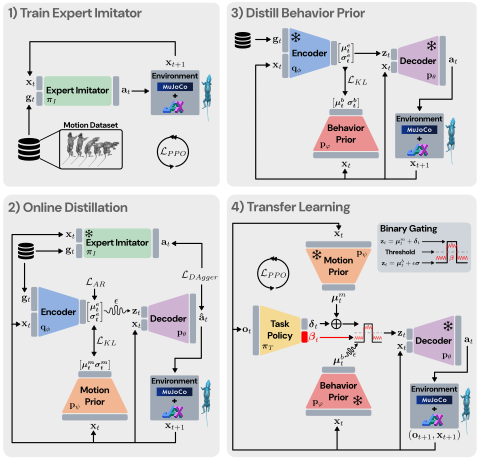
The development of embodied models of animal behavior is a major goal of the neuro-AI community. Embodied models will enhance our ability to make direct comparisons between biological and artificial agents. To make such comparisons effective, though, we need embodied models that actually move like animals. Previous work has developed virtual animal bodies and techniques for training realistic motion through imitation. However, to-date, there is no system for embodied animal modeling that produces natural movements both during trained, goal-directed behavior, and during exploration driven by random generation. Here, we introduce Simulated Control via Augmented Motor Priors for Embodied Reinforcement learning (SCAMPER), a system for training an embodied virtual rat model, enabling natural movements during both goal-directed behavior and random exploration. SCAMPER uses a variational architecture with two distinct priors, a motion prior for control and a behavior prior for exploration. We show that combining both of these priors allows SCAMPER to generate realistic behavior during exploration and exploit the task structure effectively. As well, SCAMPER can learn from sparse rewards as a result of the diverse movements induced by the behavior prior, allowing the system to model realistic sparse reward tasks from experimental neuroscience. Altogether, SCAMPER provides the neuro-AI community with an effective new system for training embodied models of rodents on realistic tasks.
Overview
Imitation & Random Motion Generation
Locomotion Task
Rearing Task
Arena Forage Task
In order to effectively solve the arena foraging task, SCAMPER dynamically gates between stochastic sampling of its behavior prior (exploration) and residual control of its motion prior (exploitation). The task policy network outputs a gate logit, $\beta_t$, which is binarized to $b_t \in \{0,1\}$ via hysteresis thresholding. This mechanism allows SCAMPER to generate realistic motion during early exploration in absence of a reward signal. As the agent discovers treats and begins receiving a reward signal, SCAMPER begins relying on residual control of the motion prior to exploit the task structure.
BibTeX
@inproceedings{sirbu2026scamper,
  title     = {{SCAMPER}: A Latent Control Model for Realistic Rodent Motion},
  author    = {Sirbu, Aidan and Zhang, Charles Y. and Yang, Yuanjia and {\"O}lveczky, Bence P. and Pereira, Talmo D. and Richards, Blake A.},
  booktitle = {Advances in Neural Information Processing Systems (NeurIPS)},
  year      = {2026}
}